Make this page easier to read
Your choices are saved on this device.
A hand-cranked freezer put an ice-and-salt bath around a turning can of cream. The machinery explains the changing resistance at the handle; the people taking turns made the work memorable.
The appeal of a hand-cranked ice-cream maker was never that it saved effort. Ice had to be found and broken up, the mixture made, and the bucket assembled before anyone could take the handle. When the crank became harder to turn, the promise of dessert felt closer. A person who remembers a particular summer may remember the order of helpers as clearly as the flavor.
What did the crank actually do?
The outer bucket held ice and salt around a metal can containing the mixture. A dasher stirred inside while a crank turned the mechanism. The Smithsonian's circa-1910 Polar Star freezer preserves the bucket, cream can, scraper, crossbar, and crank together. Its maker even stamped instructions on the crossbar to keep turning once freezing began.
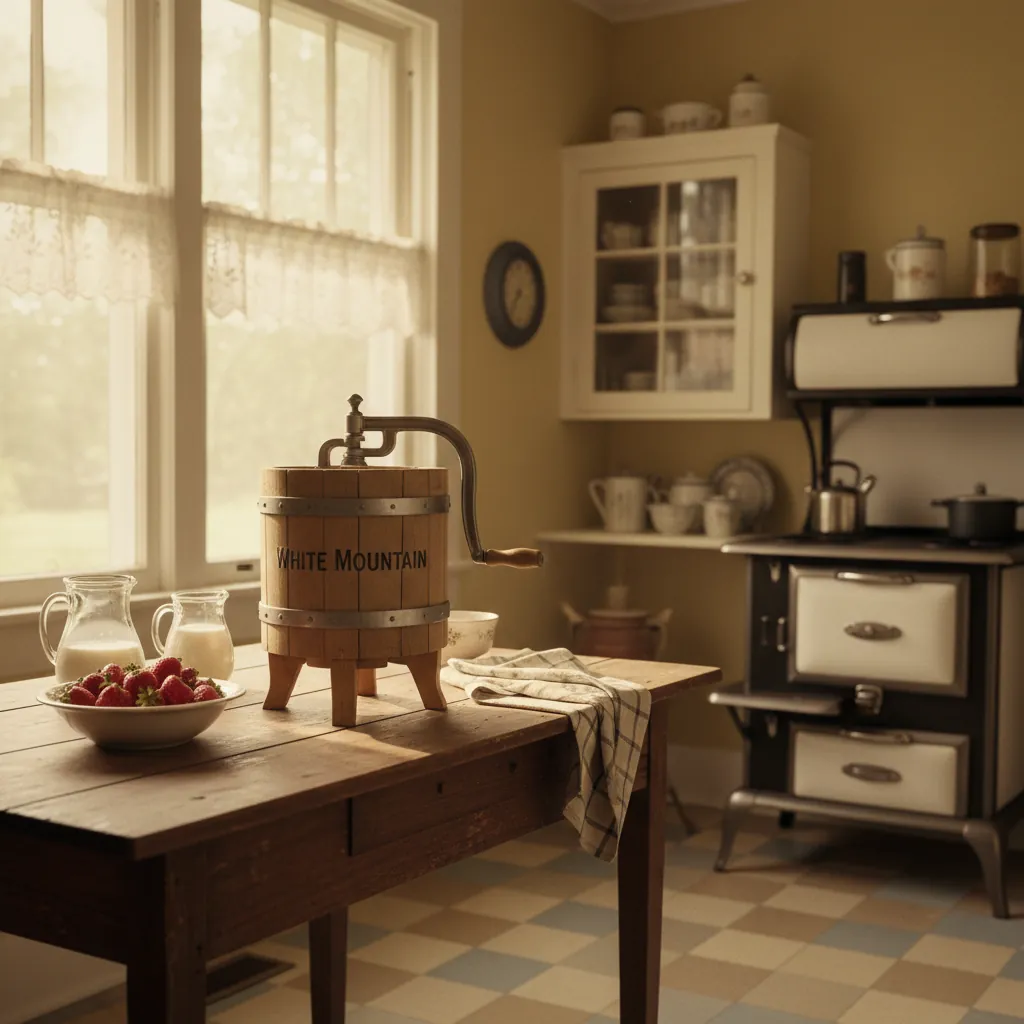 Illustration created for WistMem; not an archival photograph.
Salt belonged in the ice bath, not in the sweet mixture. It helps the ice-and-water bath get cold enough to draw heat out of the can; the Science Buddies explanation of freezing-point changes connects that principle directly to old-fashioned ice-cream makers. Meanwhile, the dasher moved the mixture against the chilled wall. As it thickened, turning required more effort. That resistance made the job easy to share: one person could surrender the handle to another.
How old was this summer ritual?
Hand-cranking was already a nineteenth-century solution to making ice cream. The National Museum of American History traces an 1843 patent by Nancy Johnson for a freezer with an inner chamber and outer pail. Its collection also holds a large 1876 Mills freezer built for much greater capacity than a small family bucket. The machines differed in size and gearing, so an inherited freezer is worth identifying by its maker's marks rather than assuming it is the same as one in a photograph.
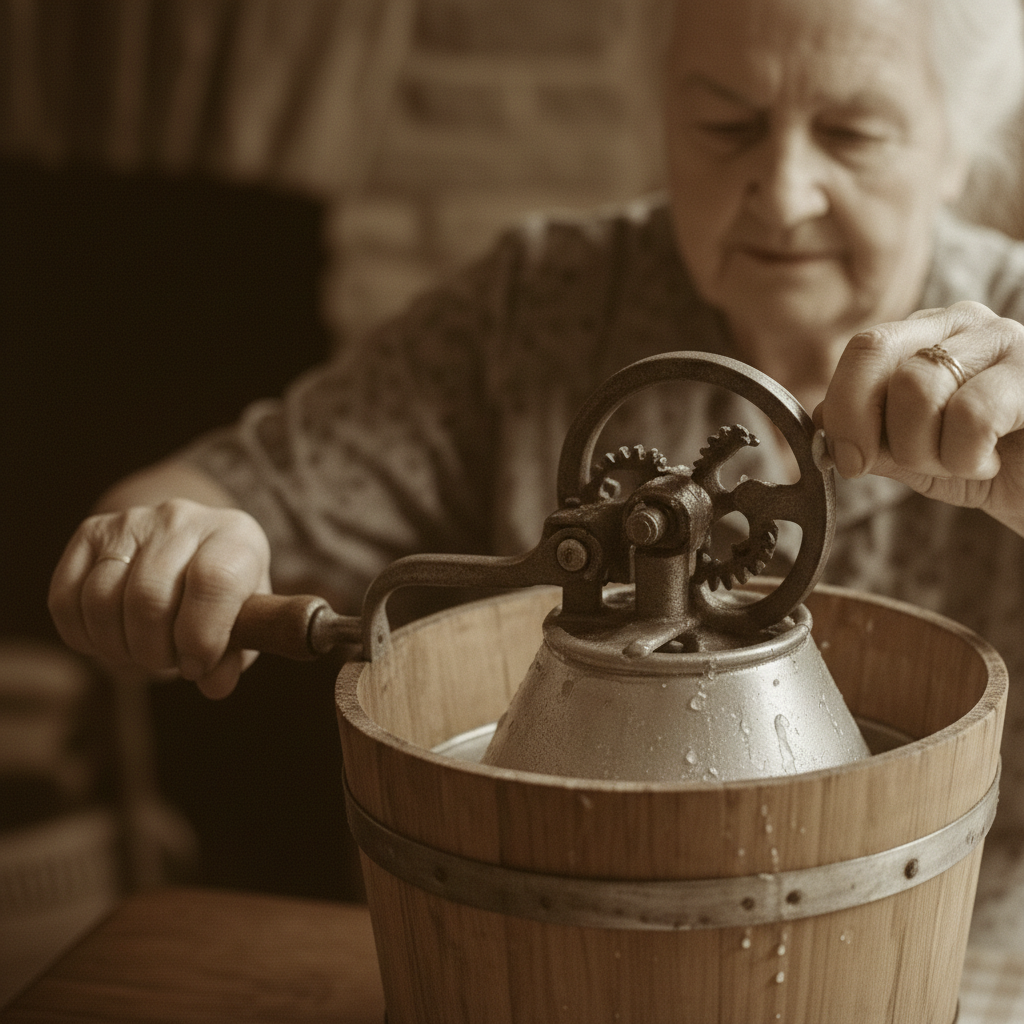 Illustration created for WistMem; not an archival photograph.
The event did not end the moment the crank stopped. There was a lid to lift, a dasher to scrape, and usually an argument over who got the first taste. If a relative remembers doing the hard final turns, ask who prepared the mixture and whether the flavor came from a garden, a shop, or a familiar family recipe. Those answers make one household's ice cream different from the general history of the machine.
For a different kitchen task shared across seasons, read The Canning Season in Late Summer.
What does it bring back for you?
Ask someone who remembers, or begin with your own version. A few words can be enough.
What everyday sound or smell brings back a home you remember?
Then ask: Who was there, and what were they doing?
Find more conversation starters Choose what feels comfortable. Ask before recording or sharing someone’s words.Relive the Memory
Find a little of the story.
Something here bring back a memory? Take a look at what you can find today.
Searching for: vintage antique hand cranked ice cream
Vintage & collectible finds
Look for older objects and collectibles connected to this memory.
Search eBay (opens in a new tab)Related finds on Amazon
Explore items related to the same topic, from familiar styles to things made today.
Search Amazon (opens in a new tab)These links open search results. Items, prices, and availability vary.
Affiliate links. We may earn a commission at no extra cost to you.
As an Amazon Associate I earn from qualifying purchases. As an eBay Partner, WistMem may earn from qualifying purchases.
Does this bring back memories?
Share this story with someone who would remember.