Make this page easier to read
Your choices are saved on this device.
Before smart boards and digital screens, the overhead projector anchored the classroom with its warm hum, acetate sheets, and bright rectangle of magnified light.
"The focus knob would be adjusted, bringing the text from a blurry mess into sharp clarity."
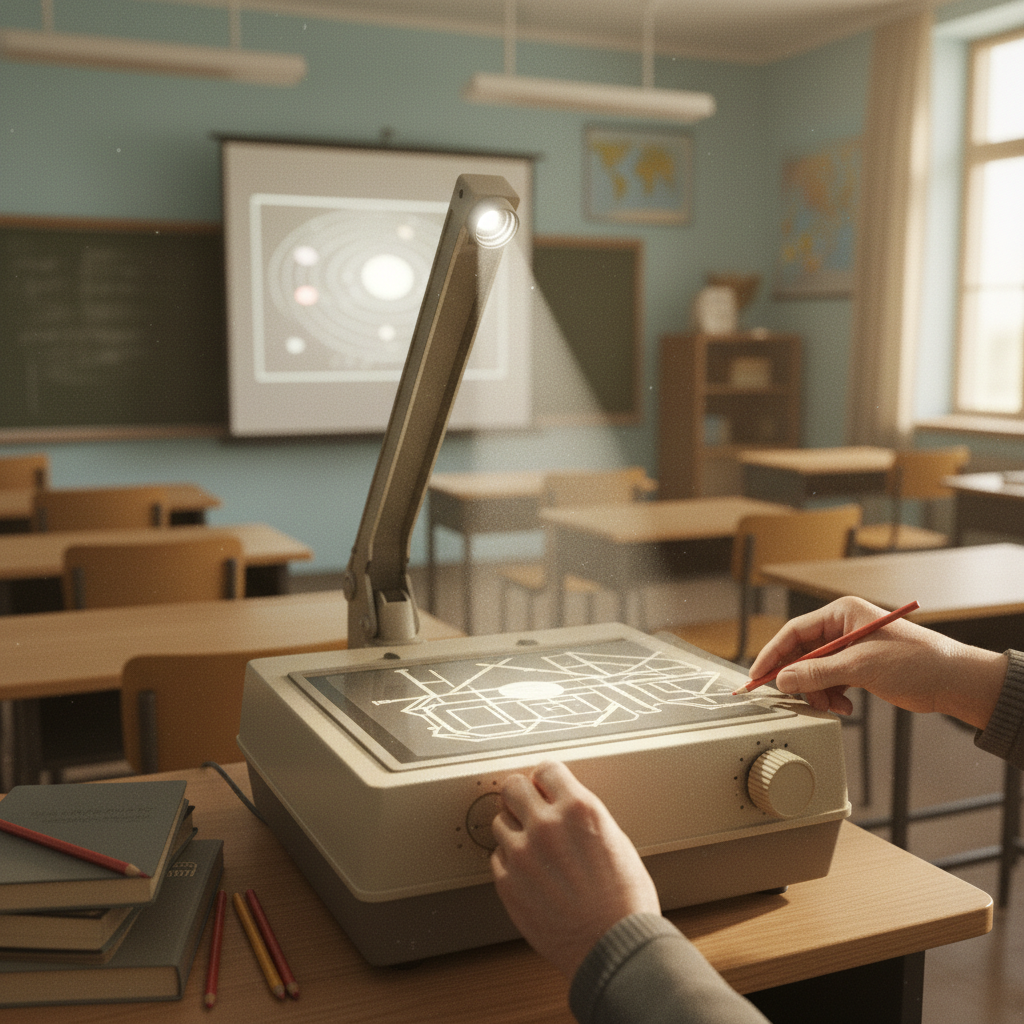
A teacher clicks a toggle switch on the base of a heavy metal cabinet, and a loud internal fan begins to whir. Instantly, a blinding rectangle of light projects upward from a horizontal glass stage, hitting an adjustable angled mirror perched on a tall metal arm above. That mirror catches the beam and throws it forward onto a pull-down wall screen, illuminating the front of the classroom while the lights overhead are switched off.
The core of the machine relied on a powerful halogen bulb sitting beneath a thick Fresnel lens. This optics setup allowed anything placed on the glass to scale up massively against the wall. Teachers utilized clear acetate sheets, writing on them with specialized water-soluble or permanent markers that emitted a sharp, chemical scent of alcohol and dye.
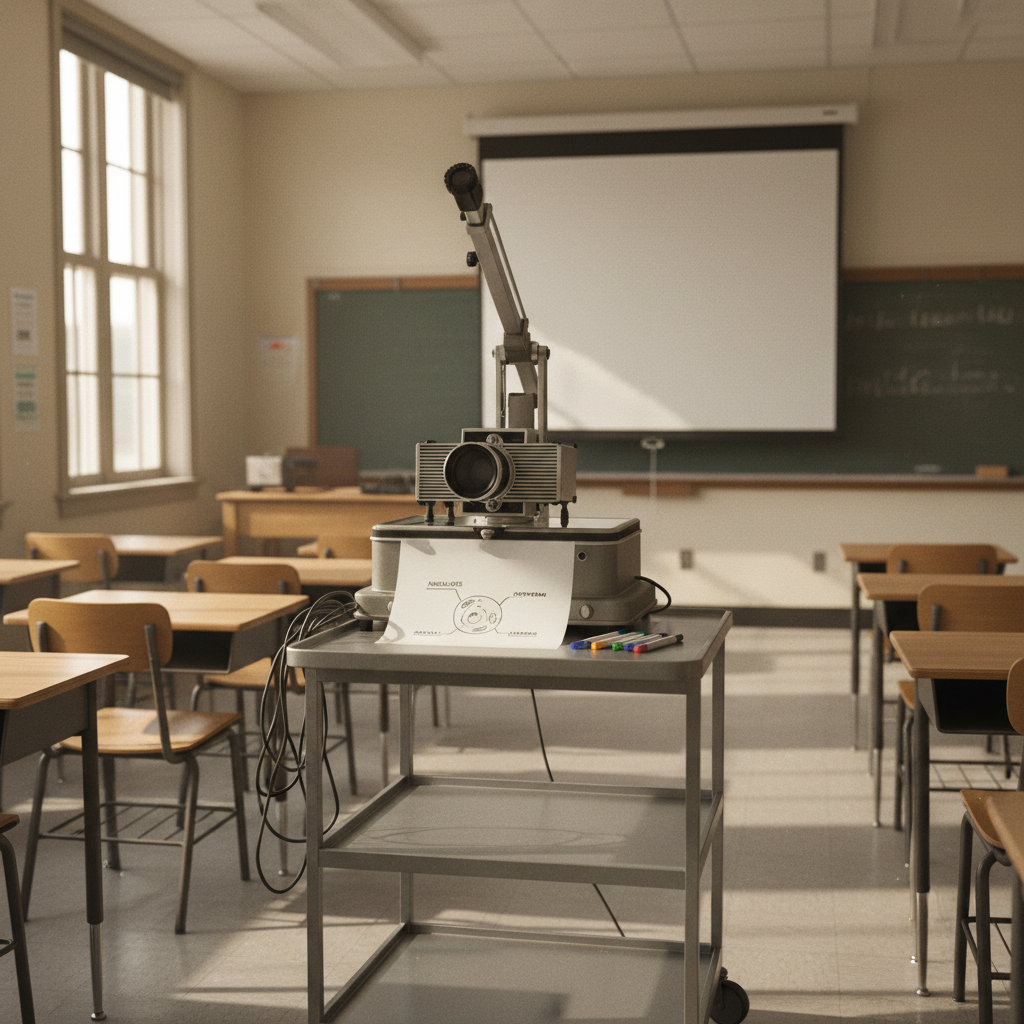
Mistakes on the acetate were easily fixed with a damp sponge or a swipe of a tissue right off the glass surface. For complex lessons, educators prepared multi-layered transparencies. By lifting one plastic sheet to reveal another underneath, they could demonstrate sequential steps in math equations, historical troop movements, or the internal anatomy of a frog without erasing their work.
Students sat in rows facing the glowing screen, watching the instructor's hand enter the perimeter of the glass stage. A pen scratching across plastic produced a distinct squeak, and rings or bracelets cast giant, wandering shadows across the projected diagrams. When the text looked hazy, the teacher reached out to twist a ridged plastic focus knob on the lens assembly until the letters snapped into sharp definition.
These projectors weighed a considerable amount, requiring a sturdy rolling cart with rubber casters to move between classrooms. The lamp generated intense heat during a full day of lessons, and teachers learned never to touch the housing unit immediately after dismissal. Changing a burned-out bulb required waiting for the interior to cool down before opening a latched compartment underneath the glass.
By the late 1990s and early 2000s, schools began swapping out these analog workhorses for digital data projectors, interactive whiteboards, and computer workstations. The acetate sheets and special markers were replaced by slide decks and digital files sent over local networks. The old machines ended up relegated to dusty storage closets, marking the end of an era defined by a single glowing pane of glass.
Does this bring back memories?
Share this story with someone who would remember.
Relive the Memory
Find Vintage Treasures on eBay
Searching for: vintage electronics overhead projector classroom
Shop the Memory on eBayAs an eBay Partner, WistMem may earn from qualifying purchases.