Make this page easier to read
Your choices are saved on this device.
Before shopping malls and online delivery, the travelling salesman transformed the domestic dining room table into a bustling marketplace of goods and conversation.
"He smelled faintly of pipe tobacco and the crisp paper of his order forms."
The latch of the leather sample case clicked open with a distinct metallic snap, releasing an aroma of oiled leather, printed paper, and faint pipe tobacco. Standing on the front porch, the travelling salesman adjusted his fedora and offered a practiced, polite smile to the homeowner who had just answered the bell. He was a familiar fixture of mid-century neighborhoods, arriving unannounced but rarely unwelcome on quiet weekday afternoons.
Households in the 1950s and 1960s saw these visits as a routine commercial exchange wrapped in social custom. Mothers wiping flour from their aprons would often invite the man inside, guiding him to the dining room table where he systematically laid out his inventory. Brushes of varying stiffness, gleaming aluminum cookware, and thick multi-volume encyclopedias were displayed with careful precision across the polished wood.
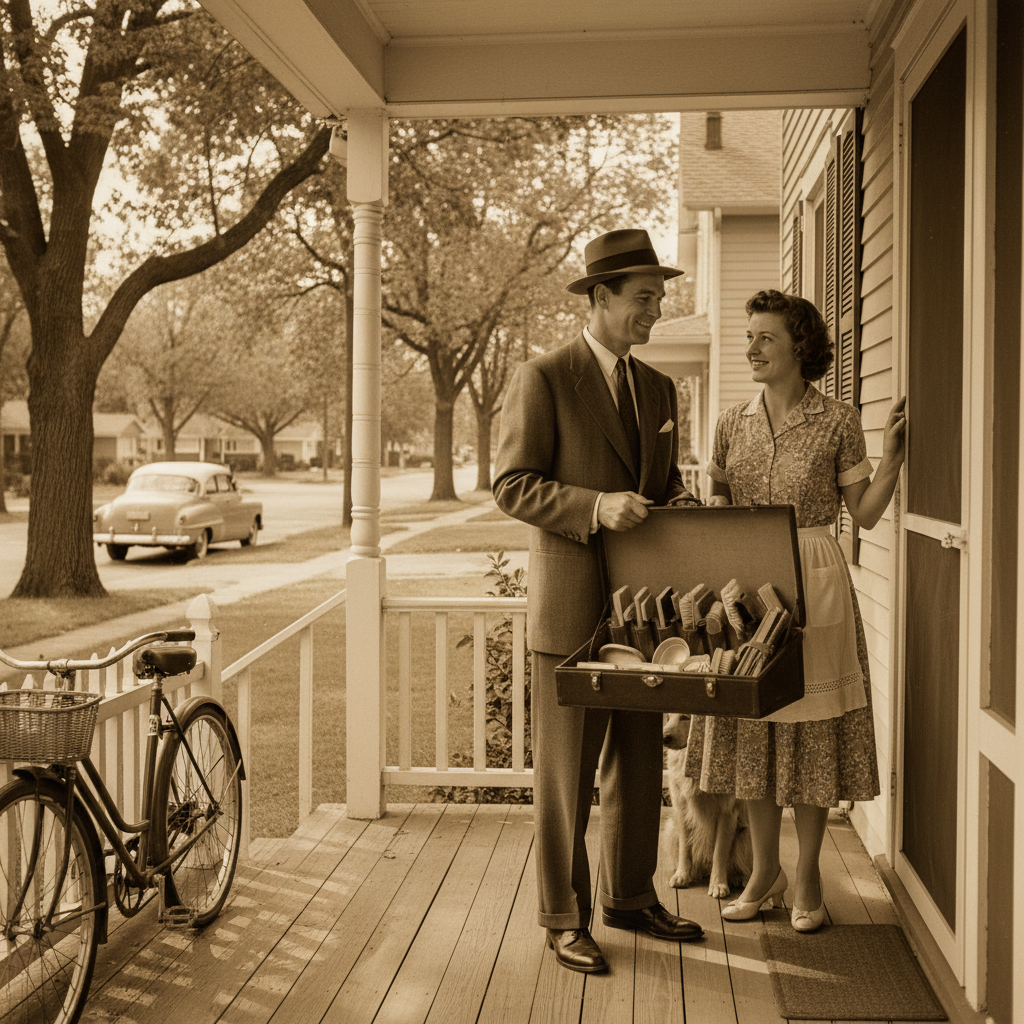
Sales representatives worked for established outfits like the Fuller Brush Company, Rawleigh, or major publishing houses, travelling established routes from town to town. Their pitch relied on tactile demonstration rather than passive viewing. A housewife could run her fingers over the rich fabric swatches, test the balance of a heavy-duty broom, or flip through the slick, colorful pages of a sample book detailing world history and geography.
These transactions required patience and negotiation on both sides. Purchases were frequently made on installment plans, with the salesman recording payments in small ledger books and returning weeks later to collect the next modest sum. Trust was built over repeated visits, as the representative learned family names, inquired about local garden yields, and occasionally shared news from neighboring towns.
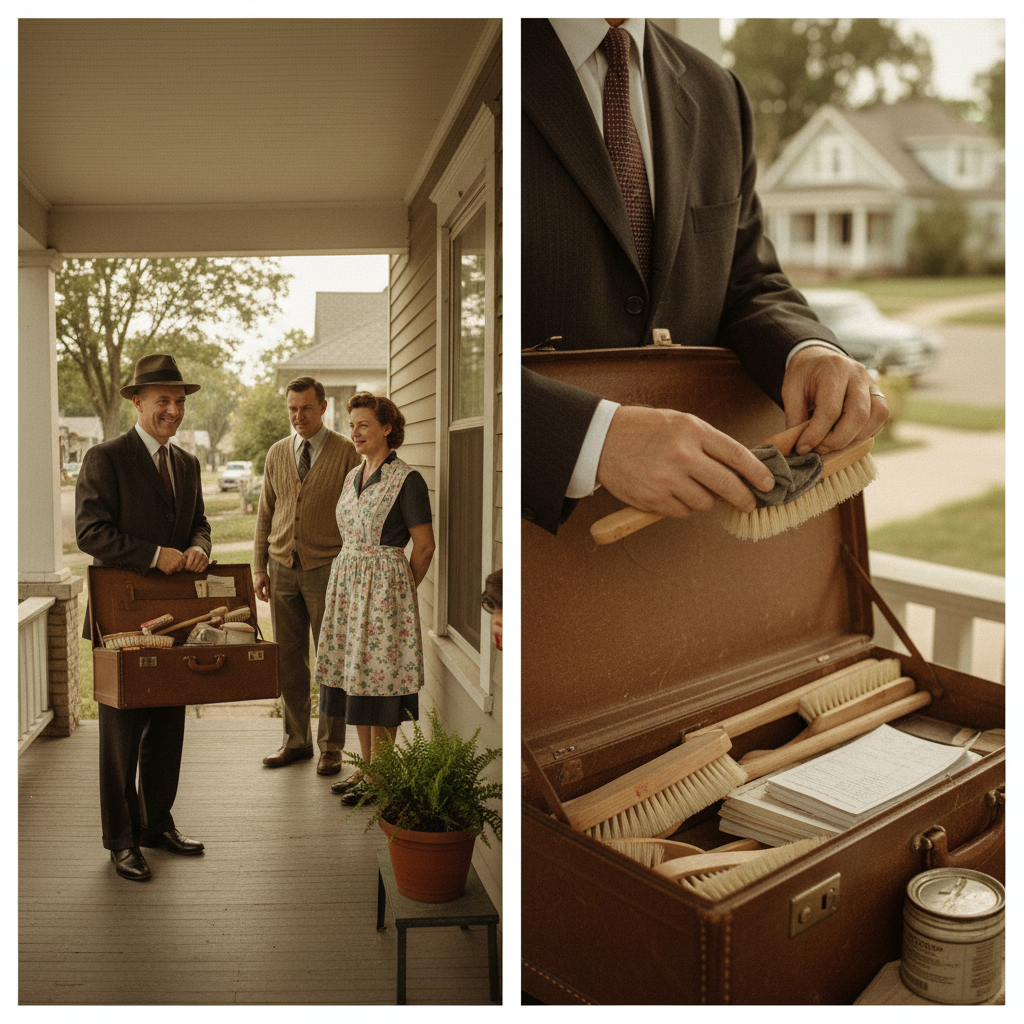
The interaction provided a deliberate break in the domestic rhythm of the household. While the salesman worked to secure an order for a new vacuum attachment or a set of reference books, children watched from doorways, fascinated by the strange array of objects spread across the family table. It was a personal method of commerce that relied entirely on face-to-face persuasion and community familiarity.
By the late 1970s, this way of selling receded as regional shopping centers and sprawling department stores centralized retail purchasing. Television advertising shifted consumer habits toward mass-market brands available under one roof, rendering door-to-door solicitation inefficient and increasingly rare.
The travelling salesman eventually vanished from residential streets, replaced first by mail-order catalogues and later by digital storefronts. What remains is the distinct memory of heavy sample cases, the rustle of crisp order forms, and an era when commerce arrived on foot with a knock at the front door.
Does this bring back memories?
Share this story with someone who would remember.
Relive the Memory
Find Vintage Treasures on eBay
Searching for: vintage antique travelling salesman your
Shop the Memory on eBayAs an eBay Partner, WistMem may earn from qualifying purchases.